성공사례
Infortrend는 중앙 연구원의 그리드 스토리지 환경 구축 공사의 참여권을 획득
프로젝트
중앙 연구원의 그리드 컴퓨터팀과 협력하여 더욱 믿은직하고 쾌속적이며 용량이 큰 그리드 컴퓨팅의 저장공간을 구축한다.
도전
솔루션
- EonStor FibreI to SATA
- 디스크 어레이 A24F-G2224
Infortrend는 중앙 연구원의 그리드 스토리지 환경 구축 공사의 참여권을 획득
THE SCIENCE OF DATA STORAGE
Using this around-the-clock worldwide grid, the WLCG project provides long-term, stable grid computing resources and data services for scientists anywhere in the world. To meet the project requirements, ASGC started expanding their storage capacity in 2006 in order to fully support global collaboration by 2009.
MAXIMUM STORAGE, MINIMUM RISK
After thorough consideration and evaluation, ASGC decided to adopt 24-bay RAID arrays from Infortrend because of the systems’ huge storage capacity, solid form factors, and rich functionalities. The EonStor A24F-G2224 Fibre Channel-to-SATA-II RAID subsystem comes in a heavy-duty 4U enclosure that can house up to 24 SATA hard drives. As with all of Infortrend’s systems, the A24F supports all current RAID levels, including RAID6 which allows for two drive failures without system interruption or loss of data. This is particularly important because while SATA drives provide high capacity at a low cost, they are not as robust as Serial Attached SCSI (SAS) or Fibre Channel (FC) drives. ASGC was able to implement RAID6 to get the system reliability and data security they needed with no degradation in performance.
Further protection is also offered by Infortrend’s other functionalities, such as DrvSmart and SysSmart, which constantly scan hard drives for potential bad blocks and repair them before the defects can produce data inconsistencies. System auto-shutdown and automatic cache flush help prevent further damage. In the event that any drive or hardware failures do occur, Infortrend’s RAIDWatch® management software immediately notifies the storage manager so that problems can be corrected as soon as possible in order to reduce the possibility of system shut down and data loss.
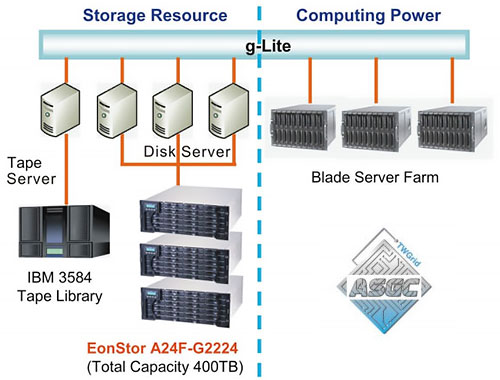
ABOUT GRID COMPUTING
Grid computing enables the sharing, selection, and aggregation of resources distributed across multiple administration domains. Using a set of open standards and protocols, information such as applications, data, processing power, storage capacity and a vast array of other computing resources can be accessed over the Internet based on resource availability, capacity, performance, and users’ requirements. Over the years, grid computing has gradually gained prominence in academic and research fields including high-energy physics, bio-informatics, and digital archives which demand greater storage capacities in order to contain the deluge of data being created.
About ACADEMIA SINICA GRID COMPUTING (ASGC)
ACADEMIA SINICA GRID COMPUTING (ASGC) in Taiwan has been developing and maintaining escience system applications since 2002. ASGC is the only Tier-1 center for the Worldwide LHC Computing Grid (WLCG) in Asia, and is also the Asian center of the Enabling Grid for E-Science (EGEE). YenHsin Chen, senior manager of ASGC, commented that the value of grid computing lies in its ability to share, integrate, calculate, and save data via the Internet. WLCG is the first and biggest worldwide grid application project, spanning 45 countries, 237 research units, and producing 15PB (petabytes) of data every year. Once processed, the data will be saved and distributed to 11 Tier-1 centers worldwide.